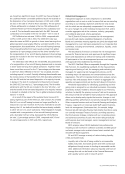
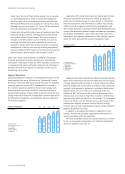
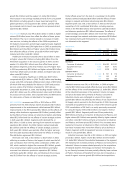
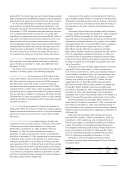
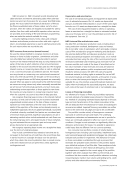
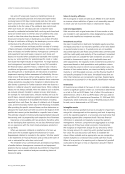
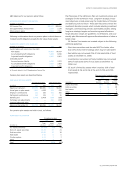
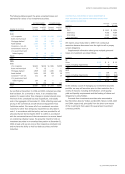
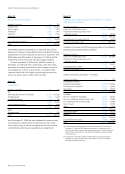
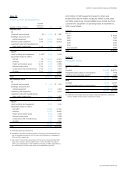
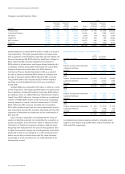
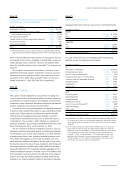
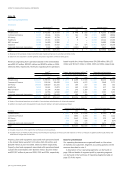
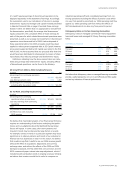
Counterparty credit risk We manage counterparty credit risk, the risk that counterparties will default and not make payments to us according to the terms of the agreements, on an individual counterparty basis. Thus, when a legal right of offset exists, we net certain exposures by counterparty and include the value of collateral to determine the amount of ensuing exposure. When net exposure to a counter- party, based on the current market values of agreements and collateral, exceeds credit exposure limits (see following table), we take action to reduce exposure. Such actions include prohibiting additional transactions with the counterparty, requiring collateral from the counterparty (as described below) and terminating or restructuring transactions. Swaps are required to be executed under master agreements containing mutual credit downgrade provisions that provide the ability to require assignment or termination in the event either party is downgraded below A3 or A–. In certain cases we have entered into collateral arrangements that provide us with the right to hold collateral (cash or U.S. Treasury or other highly-rated securities) when the current market value of derivative contracts exceeds a specified limit. We evaluate credit risk exposures and compliance with credit exposure limits net of such collateral. Fair values of our derivatives assets and liabilities represent the replacement value of existing derivatives at market prices and can change significantly from period to period based on, among other factors, market movements and changes in our positions. At December 31, 2006, our exposure to counterparties, after consideration of netting arrangements and collateral, was about $1,400 million. notes to consolidated financial statements Following is GECS policy relating to initial credit rating requirements and to exposure limits to counterparties. COUNTERPARTY CREDIT CRITERIA Credit rating Moody’s S&P Foreign exchange forwards and other derivatives less than one year P–1 A–1 All derivatives between one and fi ve years Aa3(a) AA–(a) All derivatives greater than fi ve years Aaa(a) AAA(a) (a) Counterparties that have an obligation to provide collateral to cover credit exposure in accordance with a credit support agreement must have a minimum A3/A–rating. EXPOSURE LIMITS (In millions) Minimum rating Exposure(a) Without With collateral collateral Moody’s S&P arrangements arrangements Aaa AAA $100 $75 Aa3 AA– 50 50 A3 A– 5 — (a) For derivatives with maturities less than one year, counterparties are permitted to have unsecured exposure up to $150 million with a minimum rating of A–1/P–1. ge 2006 annual report 103

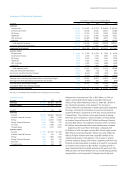
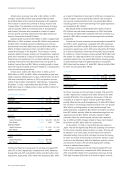
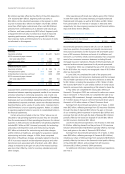
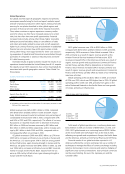
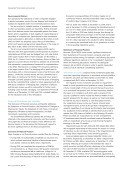
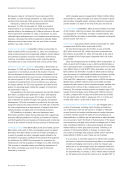
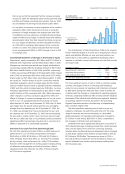
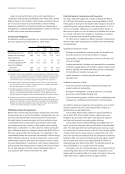
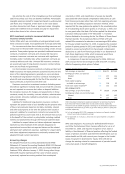
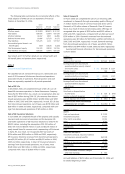
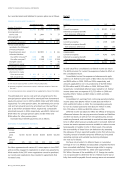
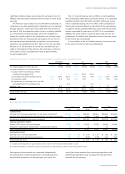
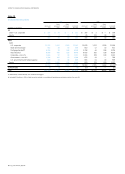
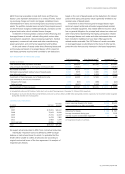
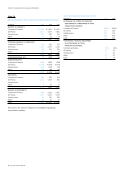
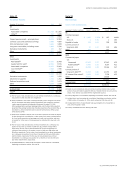
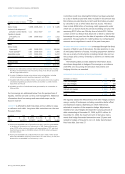
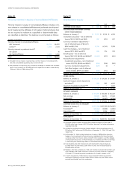
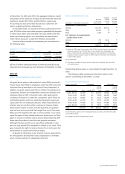
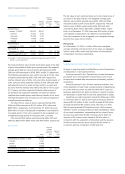
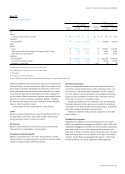
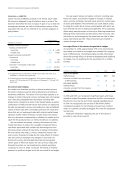
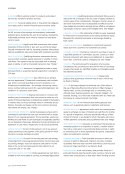
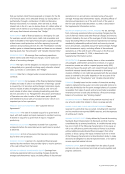
notes to consolidated financial statements Note 28 Securitization Entities We securitize financial assets in the ordinary course of business to improve shareowner returns. The securitization transactions we engage in are similar to those used by many fi nancial institutions. Beyond improving returns, these securitization transactions serve as funding sources for a variety of diversified lending and securities transactions. Historically, we have used both GE-supported and third-party entities to execute securitization transactions funded in the commercial paper and term bond markets. Securitized assets that are on-balance sheet include assets consolidated upon adoption of FIN 46, Consolidation of Variable Interest Entities (the predecessor to FIN 46R). Although we do not control these entities, consolidation was required because we provided a majority of the credit and liquidity support for their activities. A majority of these entities were established to issue asset-backed securities, using assets that were sold by us and by third parties. These entities differ from others included in our consolidated financial statements because the assets they hold are legally isolated and are unavailable to us under any circumstances. Repayment of their liabilities depends primarily on cash fl ows generated by their assets. Because we have ceased transferring assets to these entities, balances will decrease as the assets repay. We refer to these entities as “consolidated, liquidating securitization entities.” The following table represents assets in securitization entities, both consolidated and off-balance sheet. December 31 (In millions) 2006 2005 Receivables secured by Equipment $ 9,590 $12,949 Commercial real estate 11,324 13,010 Residential real estate 7,329 8,882 Other assets 14,743 12,869 Credit card receivables 12,947 10,039 Trade receivables, principally GE 3,918 3,960 Total securitized assets $59,851 $61,709 December 31 (In millions) 2006 2005 Off-balance sheet (a)(b) $48,204 $43,805 On-balance sheet(c) 11,647 17,904 Total securitized assets $59,851 $61,709 (a) At December 31, 2006 and 2005, liquidity support amounted to $753 million and $1,931 million, respectively. These amounts are net of $3,034 million and $3,786 million, respectively, participated or deferred beyond one year. Credit support amounted to $3,815 million and $5,988 million at December 31, 2006 and 2005, respectively. (b) Liabilities for recourse obligations related to off-balance sheet assets were $27 million and $93 million at December 31, 2006 and 2005, respectively. (c) At December 31, 2006 and 2005, liquidity support amounted to $6,585 million and $10,044 million, respectively. For December 31, 2005, this amount is net of $138 million participated or deferred beyond one year. No amounts have been participated or deferred beyond one year at December 31, 2006. Credit support amounted to $2,926 million and $4,780 million at December 31, 2006 and 2005, respectively. The portfolio of financing receivables consisted of loans and financing lease receivables secured by equipment, commercial and residential real estate and other assets credit card receivables and trade receivables. Examples of these assets include loans and leases on manufacturing and transportation equipment, loans on commercial property, commercial loans, and balances of high credit quality accounts from sales of a broad range of products and services to a diversifi ed customer base. Assets in consolidated, liquidating securitization entities are shown in the following captions in the Statement of Financial Position. December 31 (In millions) 2006 2005 Financing receivables — net (note 13) $11,509 $16,615 Other assets 138 1,289 Total $11,647 $17,904 Off-balance sheet arrangements We engage in off-balance sheet securitization transactions with third-party entities and use public market term securitizations. As discussed above, assets in off-balance sheet securitization entities amounted to $48.2 billion and $43.8 billion at December 31, 2006 and 2005, respectively. Gross securitization gains amounted to $1,199 million in 2006 compared with $939 million in 2005 and $1,195 million in 2004. Amounts recognized in our financial statements related to sales to off-balance sheet securitization entities are as follows: December 31 (In millions) 2006 2005 Retained interests $4,760 $4,515 Servicing assets 9 29 Recourse liability (27) (93) Total $4,742 $4,451 • RETAINED INTERESTS. When we securitize receivables, we determine fair value of retained interests based on discounted cash flow models that incorporate, among other things, assumptions about loan pool credit losses, prepayment speeds and discount rates. These assumptions are based on our experience, market trends and anticipated performance related to the particular assets securitized. We classify retained interests in securitized receivables as investment securities and mark them to fair value each reporting period, updating our models for current assumptions. These assets decrease as cash is received in payment. When the carrying amounts exceed fair value, we evaluate whether the unrealized loss is other than temporary and, if so, record any indicated loss in earnings currently. 104 ge 2006 annual report
Purchased from Demo (abedemo.tizrapublisher.com) for the exclusive use of unknown.
© 2026 Demo. Please report unauthorized use to pirate@tizra.com